

Is Duel Casino legit, and what is it?
Duel opened in 2025 and by the middle of 2026 it was moving more money than operators three times its age. That is the first thing worth saying, because most casino reviews open with the marketing and work backwards. We would rather open with the flow: $86.4m in and $89.2m out across the last fourteen days, 54,633 unique depositing addresses on record, and a position in our index at 81.6 out of 100. Only Stake scores higher, and Stake has been running since 2017.
The operator is Immortal Snail LLC, registered as L22982, holding Anjouan licence ALSI-202411026-FI1 from an address in Charlestown, Nevis. Behind it is Ossi Ketola, a Finnish entrepreneur who trades under the name Monarch and who previously built CSGOEmpire. We will come back to him, because you cannot understand Duel’s product decisions without understanding that its founder treats the gambling industry as something to be publicly antagonised rather than joined.
What Duel sells is a single, testable proposition: it has removed the house edge from its own games, and it gives back half the edge on everything else. Both claims come with conditions. The conditions are where this review spends most of its time, because the conditions are the product.
Here is the shape of the thing before the detail. There is no welcome bonus. There is no deposit match, no free spins package, no wagering requirement to clear, because there is nothing to clear. Instead every bet you place returns 50% of the house edge to your balance immediately, and inside a daily allowance the in-house games carry no edge at all. Withdrawals are instant, crypto only, with no stated minimum. Identity verification is not requested to open an account or to cash out, until your lifetime deposits pass a threshold set by the licence.
That is an unusual package, and it is unusual in a direction that favours a specific kind of player. It is worth almost nothing to somebody who deposits fifty dollars, plays slots for an evening and leaves. It is worth a measurable amount to somebody who turns over four or five figures a month on the house games. Most reviews of this operator do not make that distinction. We think it is the only distinction that matters.

How Duel scores
4.1
out of 5
Overall rating
Duel scores 81.6 in our index, second only to Stake, from a 2025 launch. Fairness and financial transparency both score a perfect 10. The weak columns are compliance at 6.7, a catalogue of 21 providers, and account security that stops at two-factor authentication.
Bonus Offers
3.3/5Game Selection
4.0/5Payment Options
4.5/5Customer Support
5.0/5Strengths and weak points
What works
The most frictionless cashier in this batch: instant payouts, no limit, no minimum deposit, no minimum withdrawal
No deposit-wagering requirement before cashout
Matched by nobody else here
No KYC: ID verification recorded as none
Fairness and financial transparency both score 10/10 in our model
4,363 slots and a Betby sportsbook
Human 24/7 support in 1-5 minutes
Early sentiment is strong: 4.49/5 across 554 reviews with only 3 complaints
What does not
2FA protects login only — withdrawals are not 2FA-confirmed, and account notifications are off
Average house-game RTP recorded at exactly 100%
Almost certainly a reporting artifact
28 restricted countries with active geo-blocking
Only 21 providers feeding 4,363 slots
The narrowest supplier list relative to size here
Bonus rating of 6.5 is the lowest in this batch
Launched 2025 under an Anjouan licence: minimal track record
Zero Edge, and what the allowance really means
Start with the arithmetic, because the arithmetic is not complicated and almost nobody does it.
A typical online slot runs at 96% return to player. Over a long enough run, the operator keeps four cents of every dollar wagered. Wager $10,000 across a month at that rate and the expected cost of playing is $400. You will not lose exactly $400, because variance is the entire point of the exercise, but that is the number the maths is pulling you toward.
Duel’s in-house games, the ones it calls Originals, run at 100% RTP inside a daily allowance. Zero edge means the expected cost of playing is zero. Not low. Zero. Over an infinite run you break even, and every session is pure variance in both directions.
Now the conditions, which Duel publishes and most coverage of Duel skips. The allowance is $50,000 of wagers per day, with a maximum of $1,000 per individual bet. Wager beyond the daily allowance and a scaling edge applies, at which point the games settle at roughly 99%. That is still far better than the 96% market standard, but it is not zero, and the difference matters if you are the kind of player who can actually reach $50,000 of turnover in a day.
Run the numbers against a realistic session. Suppose you play Dice at $5 a bet for two hours and place 600 bets. That is $3,000 of turnover, comfortably inside the allowance. At a normal casino’s 1% dice edge you would expect to lose $30. At Duel you expect to lose nothing. Over a year of playing like that twice a week, the difference is roughly $3,100 that stays in your account rather than the operator’s.
Now suppose you are a high roller placing $1,000 bets. You hit the daily ceiling after fifty bets, which on a fast game takes a few minutes. Everything after that runs at 99%, so a further $50,000 of turnover costs you an expected $500. Still cheap. Not free.
The honest summary is that Zero Edge is a real mechanism with a real ceiling, and the ceiling is set high enough that recreational players will never touch it and serious players will hit it daily. Whether that reads as generous or as clever product design depends on which of those two you are.
One more thing worth stating plainly: zero edge does not mean you will win. It means the game is not tilted against you. Variance still applies, bankroll management still applies, and a player who chases losses at 100% RTP goes broke exactly as fast as one who chases losses at 96%. The edge only describes the drift. It says nothing about the noise, and the noise is what empties accounts.
Rakeback: half the edge, on every bet
Outside the Originals, Duel runs third-party slots and live tables that carry the same house edge everybody else’s do, because they are the same games from the same studios. What differs is what happens after the bet settles.
Duel returns 50% of the house edge as instant rakeback. Not a weekly sweep, not a claimable bonus, not a tier you unlock at some threshold. It credits as you play, with no wagering requirement, no cap and no expiry.
Take a 96% slot. The edge is 4%. Wager $100 and the long-run expectation is that the house keeps $4. With rakeback at half the edge, it keeps $2 and returns $2 to your balance as cash you can withdraw. The effective RTP moves from 96% to 98%, which is above the highest-RTP slot in most casinos’ entire catalogues.
That is a genuinely strong mechanism and it deserves to be said without qualification. It is also worth understanding why an operator would do it. Rakeback rewards volume. A player who wagers $200 a month receives about $4. A player who wagers $50,000 a month receives about $1,000. The programme costs Duel almost nothing on casual traffic and pays out heavily to the players who generate the most turnover, which are exactly the players an operator wants to keep.
Compare it to how the rest of the market handles the same problem. Stake opens nothing below $10,000 wagered. Rainbet opens at $4,000. Roobet and Gamdom run rakeback with no published threshold and no published rate, which sounds generous until you try to price it. Duel’s first tier opens at $1,000 wagered, and every tier above it publishes both its threshold and its release mechanism: the weekly boost at Silver and $10,000, paid every Saturday; the monthly at Gold and $50,000; a daily reload at Platinum I and $100,000; lossback protection at Platinum II.
That transparency is the actual differentiator. The rate might not be the highest in the market. It is the one you can calculate in advance, which across this category is rare enough to be worth something on its own.
Our index scores Duel’s bonus offering at 6.5 out of 10, which trails Stake at 7.5. The gap is not about the rate. It is that Duel’s upper tiers demand six-figure turnover, and that nothing at all arrives for signing up. If you value a headline welcome offer, Duel will disappoint you on purpose.
What you do not get, and why
There is no welcome bonus at Duel. No 100% up to $500, no 200 free spins, no no-deposit offer for registering. This is a deliberate position, and the operator states it as one.
It is worth understanding what a conventional welcome bonus actually is, because the industry has spent two decades training players to read it as free money. A typical offer of $500 with a 40x playthrough requires $20,000 of wagering before anything becomes withdrawable. At a 4% house edge, generating $20,000 of turnover costs an expected $800. The bonus is worth $500. The arithmetic is not ambiguous.
Layer on the usual conditions and it gets worse. Maximum bet caps while the bonus is active, so you cannot clear it quickly. Game weightings, so table games contribute 10% and the playthrough is effectively 400x on the games with the lowest edge. Maximum cashout limits, so a $500 bonus that turns into $3,000 pays out $250. Expiry windows measured in days.
Duel’s position is that removing all of that and paying rakeback instead is worth more to a player over any realistic period. For anybody who plays more than once, that is arithmetically true. For somebody who deposits once, plays through a bonus and never returns, a conventional welcome offer is worth more, and Duel is the wrong casino.
The trade-off is real and it is not hidden. What we would flag is a second-order effect that Duel does not discuss. Rakeback rewards continued play, and a mechanism that pays you more the longer you play is not a neutral thing to hand somebody with a gambling problem. A welcome bonus is a one-off with a hard edge. Rakeback has no edge and no end. That is better value, and it is also a stronger retention hook. Both are true at once.
The Originals, game by game
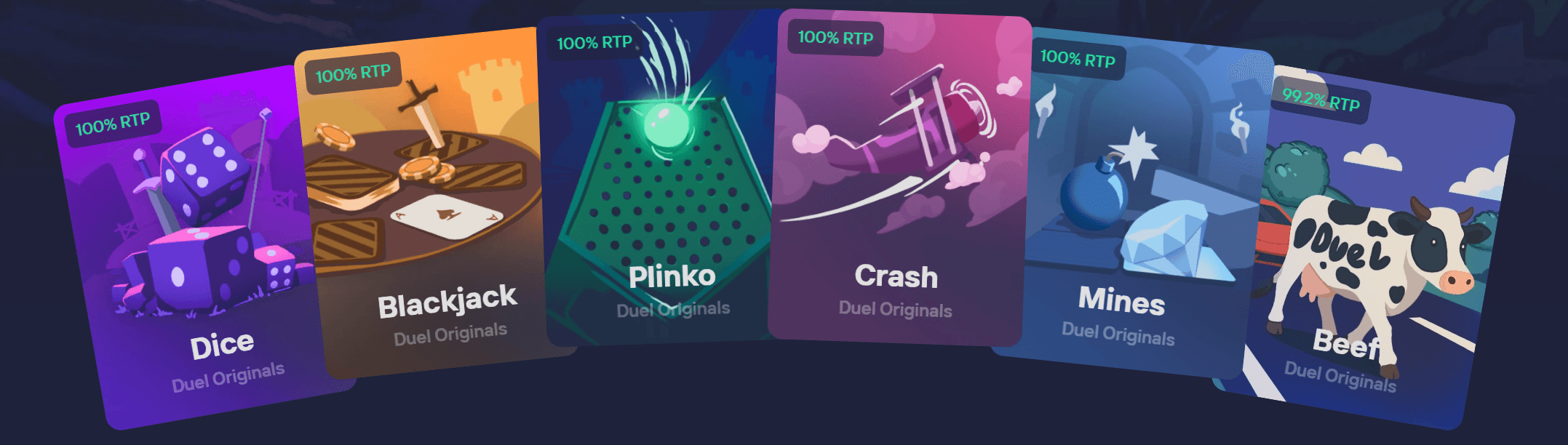
Duel Originals are the in-house games, and they are the reason the operator scores a perfect 10 on fairness and RTP in our index. Each is provably fair, each runs at 100% RTP inside the daily allowance, and each settles at roughly 99% above it.
Dice is the foundation. Pick a number, pick over or under, and the payout follows the true probability with nothing shaved off the top. At a conventional casino a 50-50 dice roll pays slightly under 2x, and that gap is the entire business model. Here it pays 2x. It is the cleanest demonstration of what zero edge means, and the easiest game on which to verify it yourself.
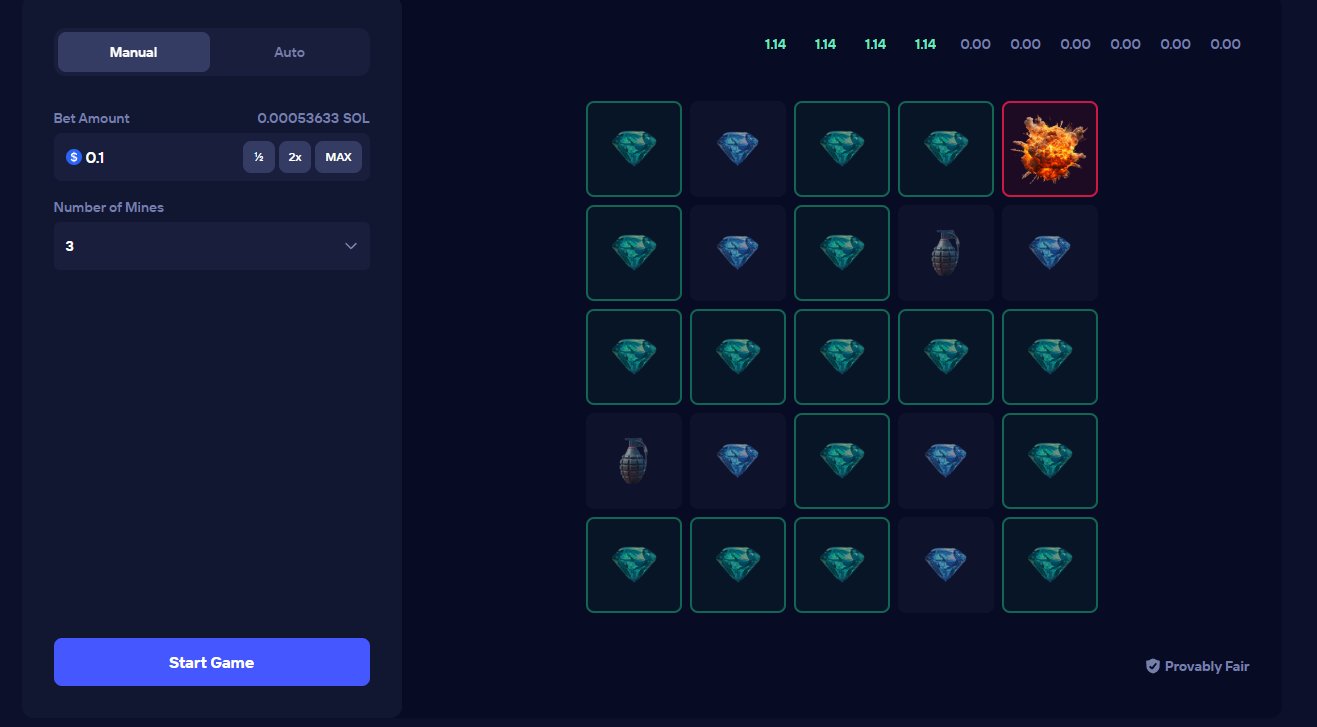
Mines puts bombs on a grid and pays a rising multiplier for each safe tile. The whole grid is seeded before your first click, which is what makes it verifiable: the layout cannot change in response to where you click, because it already exists. Initial caps sit around $10,000 per round, and support will raise limits on request for players running hot.
Plinko drops a ball through pegs into multiplier buckets. The result is committed before the animation starts. The ball bouncing down the board is a rendering of an outcome that already exists, not a physics simulation deciding anything. That distinction is the difference between a game you can verify and one you cannot.
Crash runs a multiplier upward until it stops, and you cash out before it does. It is the purest test of nerve in the category and the one where a zero edge matters least, because the money is made and lost on when you press the button rather than on the house cut.
Blackjack in the Originals lineup is dealt from a provably fair shoe rather than a live studio. Play a correct basic strategy against a 100% RTP paytable and the expected cost of the session is zero, which is not a sentence you can write about any blackjack table in Las Vegas.
Video Poker deserves a note of its own. Traditional full-pay Jacks or Better runs at 99.54%, and it is celebrated as one of the best returns on any casino floor. Duel’s build pays 100%. Half a percentage point sounds trivial. Across 10,000 hands at $5 a hand, it is the difference between an expected loss of $230 and an expected loss of nothing.
Castle Roulette, Keno, Beef and Rock Paper Scissors fill out the lineup. Castle Roulette is the interesting one: it runs with a live wheel rather than a hashed result, which means no cryptographic verification is possible, and it compensates by returning 60% of the edge as rakeback rather than the standard 50%.
The catalogue is small next to what a Stake or a Roobet offers. Twenty-one providers against Stake’s 107 is a real gap. What Duel has instead is a house lineup where the maths is stated, published and checkable, which no operator with a larger catalogue can say.

Provably fair, and the part Duel has not published
Provably fair is the term the crypto casino industry uses for a system that lets you check a result was not tampered with after the fact. It is a genuinely good idea and it is also the most oversold phrase in the sector, so it is worth walking through what actually happens.
Before you bet, the casino generates a server seed and shows you its SHA-256 hash. A hash is one-way: you cannot work backwards from it to the seed, but once the seed is revealed you can hash it yourself and confirm it matches what you were shown. You supply a client seed of your own. Each bet carries a nonce, a counter that increments. Server seed, client seed and nonce together produce the result.
The protection this gives you is specific. The casino cannot look at your bet and then pick a convenient seed, because it committed to the seed before you bet, and the commitment is checkable. Your client seed means the casino cannot know the outcome in advance either, because it does not control half the input.
What it does not protect against is worth stating with equal clarity. It says nothing about whether the payout table is fair. A game can be perfectly provably fair and still return 85%. It says nothing about whether the operator will pay you. It says nothing about the live tables, because you cannot run SHA-256 on a physical deck of cards.
Now the part specific to Duel. The construction Stake uses is publicly documented by Stake, which means anybody can implement a verifier against a written specification. Duel’s is not documented by Duel. Our sister site reconstructed a working verifier from a reference implementation and it matches every result tested against it, which is good evidence that the system does what it claims. It is not the same thing as the operator publishing its own specification.
That gap is the reason we do not simply take the perfect fairness score at face value. Duel scores 10 out of 10 on fairness and RTP in our index, which is the highest result we record for any operator. That score reflects published RTP figures, a working seed system, a verification tool and consistent behaviour under testing. It does not reflect an independent audit, because there is not one.
There is a related item on the same shelf. Duel publishes a High Scores board of all-time player profit, which opened at $12,341,874 when it was last checked in August 2026. It is Duel’s own data, published by Duel, unaudited. Treat it as marketing that happens to be numeric rather than as evidence.

The slot catalogue: 1,716 titles and one honest surprise
Duel gave our sister site API access to its own game catalogue, and what follows is computed from that file: 1,716 slot titles and 528 live tables, each carrying its return-to-player figure, house edge, volatility, hit ratio, maximum win and bet limits, pulled on 9 August 2026.
That access matters more than it sounds. RTP is normally the hardest number to obtain honestly. Operators publish it selectively, affiliates copy whatever the provider’s press release said, and the build actually running on a given site is frequently a different configuration of the same game. These are the figures Duel serves to its own front end.
Across all 1,716 slots the median game returns 96.36% and the mean sits almost on top of it at 96.35%. The distribution is tighter than most players assume. One game sits below 94%. Eighteen fall between 94% and 95%. Sixty-nine between 95% and 96%. And then 1,578 titles, which is 92% of the entire catalogue, live inside the single percentage point between 96% and 97%. Fifty games clear 97%.
Ninety-two per cent of a catalogue inside one percentage point is not Duel being unusual. It is what the modern slot market looks like, because studios build to the band that operators will accept. The practical consequence for you is that choosing slots on RTP alone is mostly noise. The difference between a typical 96.2% title and a typical 96.6% title is far smaller than the difference volatility will make to your evening.
The tails are where decisions live. At the top, GO Craps by Play’n GO returns a flat 100.00% with a maximum win of 12x. Book of 99 by Relax Gaming returns 99.00% and can pay 12,075x. 1429 Uncharted Seas by Thunderkick sits at 98.60%. Then a cluster of Relax and NetEnt titles at 98.00%: Money Train, Money Train 2, Dead Man’s Trail, Money Cart 2, Codex of Fortune, Blood Suckers.
GO Craps at 100% is the one worth understanding, because it looks like a mistake and is not. A game with no house edge and a 12x maximum win is a game you cannot lose money on in expectation and cannot win much on either. It is a low-variance instrument, not a jackpot. Whether that appeals depends entirely on why you are playing.
Now apply the rakeback. A 96.36% median slot with half the edge returned runs at an effective 98.18%. That is higher than every title in the catalogue except the top eleven. The single most useful thing in this section is that sentence: at Duel, the average game plus rakeback beats almost every high-RTP game anywhere else without rakeback.
One practical note. Duel runs 1,655 slots with a free-play build available, out of the full catalogue. Demo mode costs nothing and tells you more about whether you enjoy a game than any RTP figure will.

Duel live casino: 528 tables, blackjack and game depth
Live dealer games are streamed from real studios with real cards, which rules out cryptographic verification and rules out Zero Edge. The house edge here is whatever the game’s rules produce, the same as it would be anywhere. What Duel adds is the rakeback, and on Castle Roulette specifically, 60% of the edge rather than the standard 50%.
Every live table Duel runs carries a published RTP, and all 528 were pulled from the operator’s catalogue. Blackjack dominates the floor with 326 tables, and the best of them run above 99%. That is the strongest return available anywhere in a live studio, and it is available because blackjack with correct basic strategy is genuinely close to an even game before the operator’s cut.
Two studios run essentially the whole floor. Pragmatic Play Live supplies 274 tables and Evolution 234, with a further 18 from Evolution’s First Person range, which are software games dressed as live tables. If you have played live casino anywhere else in the last five years, you have played these two studios, and the experience at Duel is the experience everywhere.
What differs is the maths on top. A blackjack table at 99.5% with 50% rakeback returns an effective 99.75%. Across a $2,000 session that is an expected cost of $5. The same session at a conventional casino running the same Evolution table without rakeback costs $10. Neither number will decide your evening, but the direction is consistent.
Two things to be careful about on the live floor, both of which cost more than the house edge does.
Side bets are the first. Perfect Pairs, 21+3, Lightning multipliers and the rest carry house edges between 4% and 15%, against the 0.5% on the main hand. Rakeback applies to them too, which halves a large number into a smaller large number. A player who takes every side bet is paying more in a single hand than the base game costs across an hour.
Game show formats are the second. Crazy Time, MONOPOLY Live, Lightning Storm and the rest are excellent television and expensive gambling, typically running between 94% and 96% with enormous variance. They are the most entertaining products on the floor and the least efficient way to use a bankroll.

The sportsbook, and the widest gap we have measured
Every sportsbook in the world says it runs razor-thin margins. The margin, called the vig or the juice or the overround depending on who is talking, is the slice built into the odds. It is calculable from published prices, and almost nobody calculates it.
The method is simple. Convert each side’s decimal odds to 1 divided by the odds, add them up, and subtract 1. A perfectly fair two-way market sums to 1.00. Anything above that is the book’s expected take.
Duel’s sportsbook prices at a measured margin of 1.96%. The median crypto sportsbook sits at 6.21%. Across everything we compare on this operator, including RTP builds, trust signals and on-chain flows, this is the widest gap between Duel and the field on any single measure.
Put it in money, because a percentage does not land until it does. Stake £200 a week across a season and you turn over £10,400. At Duel’s margin the book expects to keep about £204 of that. At the median crypto book it expects £646. The £442 difference is not decided by how well you pick. It is decided before you place a single bet.
That figure is the single strongest argument for this operator, and it applies to a group of people who mostly are not reading casino reviews. If you bet on sport with any regularity, the margin is the only number that matters and it compounds across every ticket you ever place. A 4-point edge on the vig is worth more than any bonus in the sector.
The caveat is coverage. A book pricing at under 2% will not offer the breadth of markets a 6% book can afford to carry, and our index does not measure market depth. If you bet mainstream football, basketball and tennis lines, the margin is the story. If you need obscure props on minor leagues, check the coverage before you move.

Who owns Duel Casino? Ossi Ketola and Immortal Snail LLC
Most casino reviews do not discuss ownership beyond naming the licensee, because most casino ownership is a holding company that tells you nothing. Duel is different, and the difference is load-bearing for how you read the product.
Ossi Ketola, known online as Monarch, is a Finnish entrepreneur who started in the economies of online games, moved into CS:GO skin gambling when Valve introduced cosmetic items in 2013, and built CSGOEmpire in 2016 as a deliberately cleaner alternative to the rigged skin sites that dominated the space. He is now a high-stakes poker player who has sat opposite Dan Cates at Triton tables and lost seven figures in public without apparent distress.
He is also unusually candid about his own history. He has described himself as a sneaky kid who scammed other players out of virtual items before he decided transparency was a better business. That is not the sort of thing a normal gambling executive says out loud, and it is a reasonable proxy for how the company communicates generally.
Why this belongs in a review rather than a profile: Duel’s entire product is a set of claims about honesty that are difficult to audit from outside. Zero Edge, provably fair results, published RTP, a 1.96% sportsbook margin. In that situation, the track record and the incentives of the person making the claims are evidence, and they cut both ways.
On one side, Ketola built a previous business on the same positioning and it worked, which suggests the strategy is sincere rather than a launch gimmick. On the other, an owner who enjoys public confrontation with the rest of the industry has a strong incentive to make claims that are dramatic, and a single individual behind a young operator under a light regulator is a concentration of risk that a corporate structure would dilute.
Our index scores Duel at 6.7 on compliance, its weakest column by a distance. That number is not about Ketola. It is about Anjouan being a lighter regime than Curacao and about there being no independent audit of anything. But the two are connected: a founder-driven operator making unusually strong claims under an unusually light regulator is a profile where the founder’s reputation is doing work that a regulator would normally do.

On-chain: money in, money out
This is the part of the review that does not depend on taking anybody’s word for anything. Deposits and withdrawals at a crypto casino move on public blockchains, and public blockchains can be read.
Over the fourteen days to our last reading, wallets we attribute to Duel took in $86.4m and paid out $89.2m. That is a ratio of 1.03, meaning slightly more left than arrived. On a representative day the pattern was about 2,400 deposit transactions against 1,470 withdrawals, so money arrives in more numerous, smaller pieces and leaves in fewer, larger ones.
Set that against the field. Stake moved $571m in and $409m out over the same window, a ratio of 0.72, and it is the only operator on our list that accumulates rather than roughly breaking even. Roobet moved $283m and $285m. Gamdom $60.6m and $62.4m. 500 Casino $8.9m and $9.9m. Duel at $86.4m sits third by volume, ahead of Gamdom, which has been trading since 2016.
An operator launched in 2025 outrunning one launched in 2016 is the single most striking fact in Duel’s file, and it is not a claim from a press release. It is arithmetic on public ledgers.
A second dataset agrees. DappRadar tracks 141 wallets belonging to Duel across Ethereum, Solana, Tron and BNB Chain, and reads daily deposit volume at roughly $6.71m. Work the averages out and you get about $2,813 per depositing wallet and $1,111 per transaction. Our own count of 54,633 unique depositing addresses is the same phenomenon measured differently.
Two honest caveats before anybody treats these numbers as gospel. First, DappRadar’s own page reports 135 verified wallets in one place and 141 tracked in another, which is the sort of inconsistency that should make you hold the figure loosely. Second, and more important: “$6.71m a day” and “a lot of people are playing here” are different claims, and only the first one is measured. Volume can be concentrated in very few hands, and at Duel it is.
Who is actually sending the money
The distribution matters more than the total, and it is not what the marketing implies.
Tickets of $10,000 or more carry 48% of all deposit volume. Everything under $1,000, which covers essentially all recreational play, accounts for 19%. Roughly half the money flowing into this casino arrives from people depositing in five figures at a time.
That is worth sitting with, because it reframes the whole product. Zero Edge with a $50,000 daily allowance, a $1,000 maximum bet, rakeback tiers running to $100,000 of turnover, lossback protection at Platinum II. Read those in isolation and they look like generous consumer features. Read them against a deposit distribution where half the money comes in above $10,000 a ticket and they look like a product designed for exactly the players who are sending it.
None of that is a criticism. An operator building for its actual customers is behaving rationally, and the features are genuinely good if you are one of those customers. But a recreational player reading “100% RTP” and imagining the casino built that for them has the causation backwards.
Here is the practical translation. If you deposit $100 and play $500 of turnover across an evening, Zero Edge saves you about $20 against a conventional casino and rakeback adds a few dollars more. Real, and small. If you turn over $30,000 a month across Originals and slots, the same mechanisms are worth somewhere between $600 and $1,200 depending on your game mix. That is where the value is concentrated, and the numbers say that is where the players are too.
The 54,633 unique depositing addresses on record is also a number to read carefully. Addresses are not people. One player can fund from several wallets, and exchange-managed withdrawals can route many players through few addresses. It is the best proxy available for a player base and it is a proxy, not a headcount.
What the treasury holds
Reserves stand at $10.5m across 11 positions, the fewest positions of any operator we track. Measured against the median daily payout, that covers 2.4 days. Stake holds 9.9 days, Rainbet 18.7, 500 Casino 4.7. Roobet sits at 1.1 and Gamdom at 1.8, so Duel is mid-table on this measure rather than an outlier in either direction.
Just over half, 56%, sits in dollar stablecoins, which removes price risk from that portion of the balance. The chain spread runs $4.4m on Ethereum, $3.2m on Solana, $2.4m on BNB Chain and $497k on Tron.
Eleven positions is a tidy treasury for the volume passing through it. It is also thin relative to the flow: $10.5m of reserves against $86.4m of fortnightly deposits means the operator is not warehousing player money, it is cycling it. That is normal for an instant-payout casino and it is the configuration with the least margin if withdrawals spike.
Duel scores a perfect 10 on financial transparency in our index, and it is fair to ask what that score means when there is no proof-of-reserves attestation. It reflects what the operator publishes and what can be independently observed on chain, and on both counts Duel is unusually open. It does not reflect an audit. No operator we rate has one.
Read 2.4 days the way you would read any working-capital figure. It describes what is visible on public ledgers at a point in time. It is a reason to ask a question, not an answer to it.
Deposits and payment methods
Sixteen coins, no fiat rail and no stated minimum on either side. The table below lists every method our index records for the account.
1$
Min. deposit
10$
Min. withdrawal
Instant payouts
Avg. withdrawal time
Available
Instant payments
All payment methods
16
 USD Tether (USDT)
 USD Coin (USDC)
 Solana (SOL)
 Bitcoin (BTC)
 Bitcoin Cash (BCH)
 Ethereum (ETH)
 Litecoin (LTC)
 Tron (TRX)
 Binance Coin (BNB)
 Ripple (XRP)
 Dogecoin (DOGE)
 Cardano (ADA)
 Chainlink (LINK)
 Avalanche (AVAX)
 Toncoin (TON)
 Hedera (HBAR)
Cryptocurrencies
16
Accepted currencies
16
AVAX
BNB
BTC
BCH
ADA
LINK
DOGE
ETH
HBAR
LTC
XRP
SOL
TON
TRX
USDC
USDT
Payments and withdrawals
Duel settles in 16 coins, the second-widest list among the operators we rate, and takes no fiat directly. The list reaches beyond the usual set: alongside Bitcoin, Ethereum, Litecoin, Tether, USD Coin and Solana, it carries TON, Hedera, Avalanche, Cardano, Chainlink, Tron, BNB, XRP, Dogecoin and Bitcoin Cash.
Our record shows no stated minimum on either deposits or withdrawals. In practice that leaves the network fee as the only floor, which makes the cheap-settlement chains on that list worth more than their headline presence. Moving $30 out over Solana or Tron costs cents. Moving the same $30 over Ethereum during congestion can cost more than the withdrawal is worth. Ethereum still works and the gas is yours to pay.
Payouts sit in the fastest band we classify, with no monthly limit. There is no pending status and no manual approval queue for standard crypto cashouts. That is the headline feature and it is real.
Two conditions attach. A submitted withdrawal cannot be cancelled, and across a 16-coin list spanning chains as different as Bitcoin, Solana, TON and Hedera, the chance of selecting the wrong network is higher here than at an operator offering five options. Confirm the chain, not just the ticker symbol. Support cannot recover a transfer sent to the right address on the wrong chain.
For players without crypto already, Duel runs a Deposit with Cash flow that buys coins inside the wallet using a card, Apple Pay, Google Pay, bank transfer or a regional payment rail. It is a convenience layer over the same crypto rails rather than a fiat account, so the casino balance is still denominated in coins.
Support is human, replies in one to five minutes and runs around the clock, which alongside Stake and 500 Casino is the best combination on our list. That matters more at an operator with no cancel window: if you send to the wrong chain at three in the morning, the difference between a five-minute reply and a fifteen-minute one is not academic.

Opening an account, and what actually happens
Registration takes an email address and a password. There is no passport photograph, no utility bill, no address confirmation and no waiting period. The account is live immediately and the wallet accepts a deposit straight away.
For anybody who has opened an account at a licensed European operator, the absence is startling. The normal flow is register, deposit, play, and then discover at the withdrawal stage that documents are required, at which point the money sits in limbo for three days while a compliance team works through a queue. Duel removes that entirely for players under the threshold.
What to do in the first ten minutes, in the order we would do it. Turn on two-factor authentication before you deposit anything, because it is the only account protection this operator offers and an account without it is protected by a password alone. Set your client seed in the fairness panel rather than accepting the default, since a seed you chose is the half of the verification that belongs to you. Check the Zero Edge allowance display so you know where you stand against the daily $50,000 and the $1,000 per-bet cap.
Then pick your deposit coin deliberately. This is the decision that costs people money without their noticing. Depositing $200 in Ethereum during a busy hour can cost more in gas than a week of house edge would at a conventional casino. Solana, Tron and Litecoin settle for cents. The coin you deposit in is also usually the coin you withdraw in, so the choice compounds.
For players without crypto already, the Deposit with Cash flow buys coins inside the wallet using a card, Apple Pay, Google Pay or a bank transfer. It is convenient and it is not free; you pay a conversion spread that a direct crypto transfer avoids. If you plan to play here regularly, buying coins on an exchange and transferring in is cheaper.
Verification, and the €5,000 line nobody mentions
Duel is marketed as a no-KYC casino and for most players that description holds. You can register, deposit, play and withdraw without submitting a passport, a utility bill or anything else. There is no account-under-review email three days later while your deposit sits idle.
The detail that most coverage omits is where the line sits. Verification may be requested before a withdrawal or on flagged activity, and it becomes compulsory once lifetime deposits pass €5,000 under the operator’s Anjouan licence. That is a lifetime figure, not a per-transaction one, and it accumulates quietly.
So the accurate description is not “no KYC ever”. It is “no paperwork to get started, and probably none at all unless you deposit meaningfully”. For a player putting in a few hundred dollars a year, that distinction never becomes real. For anybody in the deposit bracket that carries 48% of this casino’s volume, it becomes real quickly, and it is much better to know that before you deposit than at the moment you try to withdraw a win.
This is worth comparing against how the rest of the field handles it. Stake runs full KYC before your first deposit, which is intrusive and removes the surprise entirely. Rainbet has no verification at any stage in our record. Roobet and 500 Casino operate discretionary light KYC. Duel sits between them: nothing at the door, a hard threshold further in.
Account security is where we would push back hardest on this operator. Two-factor authentication is available and that is the extent of it. There is no separate confirmation step on withdrawals, and no notification when the account is accessed from a new device. Stake has all three. 500 Casino has all three. At a casino with instant, non-cancellable payouts, a compromised session and a single 2FA code is the whole distance between an attacker and an emptied balance.

Country restrictions
Twenty-eight jurisdictions are blocked, and the composition is different from the other operators we rate. Alongside regulated European markets that license gambling themselves, the list carries Germany, Lithuania and Slovakia, and then a cluster of sanctioned states: Iran, Iraq, North Korea, Syria, Libya, Somalia, Sudan, South Sudan, Myanmar, Yemen, Mali and the Central African Republic. The United States, United Kingdom, France, Netherlands, Curacao, Australia and Venezuela are also excluded.
That reads as a sanctions-driven list layered on a licensing one, which is a different pattern from the Curacao operators here, whose exclusions track their own licence obligations almost exclusively.
Blocking is enforced at access rather than at withdrawal, which is the player-friendly ordering. You find out you cannot play before you have money on the platform, not after. Since there is no verification stage in the normal flow, that IP-level block is the only compliance control between the operator and a restricted market, so treat it as a hard boundary rather than an inconvenience. An account opened from a blocked jurisdiction has no verification step at which the problem surfaces gently. It surfaces when the account closes.
Check your country
Type a country to see whether Duel accepts players from it.
Blocked jurisdictions
Not available
- Afghanistan
- Germany
- Iran
- Iraq
- Jordan
- Kuwait
- Lithuania
- North Korea
- Slovakia
- Syria
- Yemen
- United Arab Emirates
- Montenegro
- United Kingdom
- United States of America and its territories
- France
- Netherlands
- Curaçao
- Australia
- Venezuela
- Democratic Republic of Congo
- Libya
- Somalia
- Myanmar/Burma
- Sudan
- South Sudan
- Mali
- Central African Republic
Leaderboards, and the $1,000,000 that is not for you
Duel runs two leaderboards, and the prize tables read directly from the operator’s own widget. A monthly board carrying $2,000,000 and a daily board carrying $25,000. Both pay exactly 100 places. Both hand half the entire pool to first: $1,000,000 monthly and $12,500 daily.
The drop from first to second is the steepest structure on the board, a gap of $770,000 on the monthly. That shape tells you what the board is for. It is not a distribution of value across a player base. It is a single enormous prize with a long tail attached, and the single enormous prize goes to whoever generated the most turnover that month.
Treating the $1,000,000 as something you might realistically chase is one of the more expensive mistakes available at this casino. The players contesting the top of a monthly board at an operator where 48% of deposit volume arrives in $10,000 tickets are not people you are going to outwager by trying harder.
The tail is where the honest value sits, and it is not token. Monthly positions in the nineties still paid between $190 and $400, and the daily board pays $25 down at hundredth place. A month contains around thirty separate chances to place in a $25,000 pool, against one shot at a monthly board dominated by high-volume regulars. If leaderboards interest you at all, the daily is the one with a plausible route in.
One structural note that Duel states and we will repeat: leaderboard prizes are separate from and additional to the instant rakeback. The rakeback is the main value proposition, and it pays regardless of where you finish. The boards are a lottery layered on top of it.
Live streams, and the trap in the Last 100 panel
Duel streams several of its live tables publicly, without an account and without a deposit. Castle Roulette runs in the open, exactly as it runs for people with money on it, and you can watch it for as long as you like before deciding whether the format suits you. Finding out a game bores you for free is a considerably better outcome than finding it out for $200.
Two things about that feed are worth flagging. It carries the table’s own viewer chat inside the picture and it arrives with sound, which is a surprise if you open it at work. And Castle Roulette specifically runs at a normal house edge with no Zero Edge allowance and no cryptographic verification, because you cannot run SHA-256 on a physical wheel. It compensates with 60% rakeback on that table rather than the standard 50%.
Now the part that costs people money. Above the wheel there is a panel labelled Last 100, showing how many times each multiplier landed in the last hundred spins. It looks like data. It is a trap, and it is worth understanding why, because the same panel exists at every live casino in the world.
A hundred spins is far too small a sample to say anything about a wheel. Ordinary randomness produces streaks and gaps that look meaningful and are not. Worse, the panel is a rolling window: read it three times ten minutes apart and you are looking at almost the same hundred spins, not three independent observations. The apparent confirmation is the same data shown to you again.
The wheel has no memory. A multiplier that has not landed in eighty spins is exactly as likely on the next spin as one that landed twice in the last ten. Every system built on reading that panel is a system built on noise, and the house edge collects the same either way. The one genuine use for the panel is confirming the table is live and running, which the stream already tells you.

The celebrity bookings, and what they are worth
Duel has put recognisable faces at its tables. Mike Tyson dealt blackjack. Mia Malkova took a seat at another. Ossi Ketola plays high-stakes poker in public against Dan Cates and other names from the Triton circuit, and loses seven figures without visible distress.
We mention this because it is a large part of how this operator is known, and because a review that pretends marketing does not exist is not much use. So: what is it evidence of?
It is evidence of a marketing budget and of a founder comfortable in front of a camera. It is not evidence about the maths, the reserves, the licence or whether you will be paid. A celebrity dealing a hand of blackjack has verified nothing. That sounds obvious written down and it is worth writing down anyway, because the effect of that content is to transfer a sense of legitimacy that has not been earned by anything checkable.
The same applies to the poker losses, which do double duty as marketing. A founder losing millions publicly signals that the business is large enough to absorb it, and that signal is deliberate. It is also unaudited. We know what was shown. We do not know the balance sheet behind it.
Our view is straightforward. Judge this operator on the 1.96% sportsbook margin, the published RTP distribution, the on-chain flows and the working seed verifier. Those are the things that hold up when you check them. The celebrity content is entertainment, and treating it as due diligence is how people end up on sites that are much worse than this one.

Using the allowance well
If the mechanisms here are worth anything to you, they are worth using deliberately. This section is arithmetic rather than advice, and none of it changes the fact that gambling is a cost.
Play the Originals first. Inside the daily allowance they carry no house edge. Every dollar of turnover you route through a third-party slot instead is a dollar that costs you roughly two cents after rakeback. If you intend to wager $2,000 in an evening, the difference between putting it all through Dice and putting it all through slots is about $36 in expectation. Not dramatic, and it is free.
Know where the ceiling is. The allowance is $50,000 of wagers a day and $1,000 per bet. Below $50,000 you are playing a zero-edge game. Above it you are playing a 99% game, which is still excellent and is no longer free. A player betting $10 a spin would need 5,000 spins in a day to reach the ceiling, so for most people it is theoretical. A player betting $500 hits it in a hundred bets.
Treat rakeback as a discount, not income. Returning half the edge on a 96% slot moves the effective return to 98%. You are still expected to lose 2% of everything you wager. Rakeback makes losing slower. It does not make playing profitable, and any framing that suggests otherwise is wrong regardless of who is doing the framing.
Skip the side bets. On the live floor, main-hand blackjack runs at 99.5% and side bets run between 85% and 96%. Rakeback halves the edge on both, which means it halves a very small number and a very large one. The side bets remain the most expensive thing on the table by a wide margin.
Pick your chain before you deposit. Network fees are the only floor on withdrawals here. Choosing Solana or Tron over Ethereum can be worth more across a year of small cashouts than the entire rakeback programme is on a modest bankroll.
Do not chase the monthly board. Half of a $2,000,000 pool goes to first place, and first place goes to whoever wagered most. If leaderboards appeal, the daily $25,000 board offers thirty entries a month and pays down to hundredth.
Duel against the field
Six operators, measured the same way. Here is where Duel actually sits.
Against Stake. Stake scores 91.2 to Duel’s 81.6 and the gap is real: 3,775 slots from 107 providers against 4,363 from 21, nine days of reserve cover against 2.4, full account security against 2FA alone, and a Curacao licence against Anjouan. What Duel gives you instead is no identity verification, a rewards ladder opening at $1,000 rather than $10,000, a sportsbook at 1.96% rather than 5.36%, and Zero Edge, which Stake has no answer to. Stake is the better casino by most institutional measures. Duel is the cheaper one to play.
Against Roobet. Roobet has a deeper catalogue at 6,485 slots from 70 providers and a Curacao licence. Duel has a perfect fairness score against Roobet’s rewards programme that publishes neither rate nor threshold, and 2.4 days of reserve cover against Roobet’s 1.1. Support at Roobet answers in five to fifteen minutes, the slowest here; Duel answers in one to five.
Against Rainbet. Rainbet holds 18.7 days of cover to Duel’s 2.4 and allows withdrawal cancellation, which Duel does not. Duel counters with a fairness score of 10 to Rainbet’s lower mark, human support against a bot, and a rakeback ladder opening at a quarter of Rainbet’s threshold.
Against Gamdom. Gamdom carries the largest catalogue at 6,700 slots and the weakest bonus programme in the group at 2.5 out of 10, with unpublished rates. Duel carries a smaller catalogue and the most legible rewards structure here. Gamdom holds 1.8 days of cover to Duel’s 2.4.
Against 500 Casino. 500 Casino blocks only five jurisdictions to Duel’s 28, opens rewards at zero wagered, and has stronger account controls including withdrawal confirmation and login alerts. Duel has more than eight times the deposit volume, a wider coin list and Zero Edge.
The pattern across all five comparisons is consistent. Duel wins on the mathematics of playing and loses on the infrastructure around it. If your priority is the cost per bet, it is the strongest operator on this page. If your priority is what happens when something goes wrong, it is not.
What we cannot verify
Everything above comes from three sources: public chain data, the operator’s own catalogue file, and our index. Each has limits, and at an operator whose entire proposition is honesty, the limits deserve more space than usual.
We see the wallets we have attributed. Holdings we have not identified do not appear, so $10.5m is a floor rather than a total. Duel is the youngest operator we rate, which means the attribution covers a shorter history and the chance of a gap is higher here than for a casino we have tracked for years.
Coverage is not solvency. The 2.4-day figure compares visible reserves to observed payouts. It says nothing about player liabilities, which are not published anywhere and are not observable on chain. An operator with thin cover and small liabilities is in better shape than one with deep cover and large ones, and nothing we can measure distinguishes them.
The RTP figures are the operator’s own. They come from Duel’s catalogue file, which is a better source than a press release and a worse one than an independent audit. We have no way to confirm that the build serving a given player matches the figure in the file.
The provably fair construction is undocumented by the operator. A working verifier exists and matches every result tested against it. That is strong evidence. A published specification would be proof, and there is not one.
Zero Edge has been checked against the stated conditions, not against an audit. The $50,000 daily allowance and $1,000 bet cap are published by Duel. We have not independently confirmed the behaviour of the scaling edge above the allowance.
The High Scores board is unaudited. The $12,341,874 all-time profit figure is Duel’s data, published by Duel.
There is no proof of reserves. Not for Duel and not for any operator on this site. Where an operator scores a perfect 10 on financial transparency in our index, that reflects openness relative to the field, not verification by a third party.
We publish these limits on every review because a rating that hides its own uncertainty is worth less than one that states it. On this operator specifically, where the marketing runs on claims of transparency, the gap between “unusually open” and “independently verified” is the single most important thing to keep hold of.
Who this is for, and who should walk
It suits you if you play the house games rather than the slots, and play them regularly. Zero Edge is worth real money to somebody putting through four or five figures a month on Dice, Mines, Plinko, Crash or Blackjack, and it is worth almost nothing to somebody spinning Gates of Olympus for an hour on a Friday.
It suits you if you bet on sport. A 1.96% margin against a category median of 6.21% is the largest single edge available anywhere on this site, and it compounds across every ticket for as long as you keep betting.
It suits you if you want to know the terms before you commit. Every rewards tier publishes its threshold and its release mechanism, which sounds like a low bar until you try to price Roobet’s or Gamdom’s programmes and find you cannot.
It suits you if anonymity matters and your deposits will stay under €5,000 lifetime.
Walk away if you want a welcome bonus. There is not one, there will not be one, and that is a deliberate product decision rather than an oversight.
Walk away if catalogue breadth is what you are buying. Twenty-one providers is the second-smallest selection here, and a player who wants every studio’s back catalogue will run out of new games faster than at Stake, Roobet or Gamdom.
Walk away if account security is a priority. Two-factor authentication with no withdrawal confirmation and no login alerts, combined with instant non-cancellable payouts, is the weakest protection profile on this page against the fastest exit route for a compromised account.
Walk away if you need a regulator with teeth. Anjouan supervises lightly, compliance is Duel’s weakest column at 6.7, and the operator is a year old. If a dispute goes past support, there is not much above it.
The summary we would give a friend: Duel is the cheapest place on this list to place a bet, and the one with the least behind it if something goes wrong. Those two facts are related, and which one weighs more is a question about you rather than about the casino.

Verdict
Duel is the cheapest operator on this site to place a bet with, and the one with the least infrastructure behind it if something goes wrong. Zero Edge on the house games, half the edge back on everything else, a sportsbook at a third of the category margin, and a rewards ladder that publishes every threshold. Against that: an Anjouan licence, a one-year trading history, 21 providers, 2.4 days of reserve cover and account security that stops at 2FA.
We score it 81.6, second of six. If you play the Originals regularly or bet on sport, no operator here is close on cost. If you want depth of catalogue or a regulator with teeth, three of the other five are better places to be.
Duel Casino: common questions
Is Duel Casino legit?
It operates under Anjouan licence ALSI-202411026-FI1, held by Immortal Snail LLC, registration L22982, at an address in Charlestown, Nevis. Our index scores it 81.6 out of 100, second of the six operators we rate, with a perfect 10 on both fairness and financial transparency. The weak column is compliance at 6.7, because Anjouan supervises more lightly than Curacao and there is no independent audit of anything. Public chain data shows $86.4m in and $89.2m out over fourteen days across wallets we attribute to the operator, which is consistent with a business paying people.
Does Duel really run at 100% RTP?
On its own Originals, inside a daily allowance, yes. The allowance is $50,000 of wagers a day with a maximum of $1,000 per bet. Above that a scaling edge applies and the games settle at roughly 99%. Third-party slots and live tables carry their normal house edge, reduced by 50% rakeback. So the honest version is: zero edge on the house games up to a published ceiling, and about half the market edge on everything else.
Is there a Duel welcome bonus or promo code?
There is no welcome bonus and no deposit match. Duel puts its value into 50% instant rakeback and 100% RTP Originals instead, both of which carry no wagering requirement. The referral code used across this site is VIP, which registers the account against our link. It does not unlock a deposit bonus, because there is not one to unlock.
What is Duel rakeback worth in real money?
It returns half the house edge on every bet, credited instantly with no wagering requirement, no cap and no expiry. On a typical 96% slot the edge is 4%, so wagering $100 costs an expected $4 and rakeback returns $2. That moves the effective return to 98%. Wager $10,000 in a month across slots and rakeback is worth about $200. The first tier opens at $1,000 wagered.
Does Duel require KYC?
Not to register, not to deposit and not to withdraw in the normal case. Verification may be requested on flagged activity, and it becomes compulsory once lifetime deposits pass €5,000 under the Anjouan licence. That is a lifetime total rather than a per-transaction figure, so it accumulates quietly. Below that threshold, play is genuinely anonymous.
How fast are Duel withdrawals, and is there a minimum?
Payouts fall in the fastest band we classify, with no monthly limit and no pending or manual approval queue for standard crypto cashouts. Our record shows no stated minimum on either deposits or withdrawals, which leaves the network fee as the effective floor. A submitted withdrawal cannot be cancelled, so confirm both the address and the chain before sending.
Which cryptocurrencies does Duel accept?
Sixteen: Tether, USD Coin, Solana, Bitcoin, Bitcoin Cash, Ethereum, Litecoin, Tron, BNB, XRP, Dogecoin, Cardano, Chainlink, Avalanche, TON and Hedera. There is no direct fiat option, though a Deposit with Cash flow buys coins inside the wallet using a card, Apple Pay, Google Pay or a bank transfer. Ethereum works but the gas is yours to pay; Solana and Tron settle for cents.
How many games does Duel have?
1,716 slot titles and 528 live tables, from 21 providers, plus its own Originals lineup. Across the slots the median return is 96.36% and 92% of the catalogue sits between 96% and 97%. Fifty titles clear 97%, and GO Craps by Play’n GO returns a flat 100% with a 12x maximum win. On the live floor, blackjack accounts for 326 tables and the best of them run above 99%.
Is Duel provably fair, and can I check it myself?
Yes for the Originals. Before you bet, the casino shows the SHA-256 hash of its server seed; you supply a client seed; each bet carries a nonce. After the fact you can hash the revealed seed and confirm it matches the commitment. What we would flag is that Stake publishes its construction and Duel does not. A working verifier exists and matches every result tested against it, which is strong evidence rather than proof. Live dealer tables cannot be verified this way, because you cannot hash a physical deck.
What is Duel's sportsbook margin?
A measured 1.96%, against a median of 6.21% across crypto sportsbooks. Across a season of staking £200 a week, which is £10,400 of turnover, the book expects to keep about £204 at Duel against £646 at the median. That £442 gap is decided before you place a bet, and it is the widest single advantage we have measured for this operator on any metric.
Which countries cannot use Duel?
Twenty-eight jurisdictions. Regulated markets including Germany, Lithuania, Slovakia, the United Kingdom, France, the Netherlands, Australia and the United States, plus a cluster of sanctioned states such as Iran, Iraq, North Korea, Syria, Libya, Somalia, Sudan, Myanmar and Yemen. Blocking is enforced at access rather than at withdrawal, so you find out before depositing rather than after.
How much does Duel hold in reserves?
Public chain data puts reserves at $10.5m across 11 positions, covering about 2.4 days of payouts at the median daily rate. Just over half sits in dollar stablecoins. For context, Rainbet holds 18.7 days and Roobet 1.1. That figure measures wallets we have attributed against payouts we can observe. It is not a solvency judgement, because player liabilities are not published anywhere and are not visible on chain.
Are the Duel leaderboards worth playing for?
The monthly board carries $2,000,000 and the daily $25,000, and both pay 100 places. Half of each pool goes to first, so $1,000,000 monthly and $12,500 daily, which realistically goes to whoever generated the most turnover. The tail is more useful than it looks: monthly positions in the nineties paid $190 to $400 and the daily board pays $25 at hundredth. A month offers thirty shots at the daily against one at the monthly.
How does Duel compare with Stake?
Stake scores 91.2 to Duel’s 81.6 and is the stronger operator on infrastructure: 107 providers against 21, 9.9 days of reserve cover against 2.4, full account security against 2FA alone, and a Curacao licence against Anjouan. Duel is the cheaper place to play: no identity verification, rakeback from $1,000 wagered rather than $10,000, a sportsbook at 1.96% against 5.36%, and Zero Edge, which Stake does not offer.
What are the weakest points of Duel?
Account security, which stops at two-factor authentication with no withdrawal confirmation and no login notifications, at a casino with instant non-cancellable payouts. Catalogue breadth at 21 providers. Compliance at 6.7 in our index, under a light regulator, at an operator one year old. And the absence of any independent audit, including no proof of reserves, which is true of every operator we rate but matters more at one whose marketing runs on transparency.